


The difference between a CFO and a Finance Director often looks blurry on paper, yet inside a company it shapes how money decisions are made, approved, and executed. Both roles sit at the top of the finance function, but they do not carry the same strategic weight or authority.
Understanding CFO vs Finance Director roles helps founders, CEOs, and investors build clearer reporting lines and avoid overlap. It also helps finance professionals see which path aligns better with their experience and career goals. The real distinction comes down to scope, influence, and decision rights, not just job titles.
Strategic Focus and Leadership Scope

When comparing CFO vs Finance Director responsibilities, the first major difference appears in strategic reach. A CFO usually operates at board level and is involved in shaping long-term business direction. Capital structure, funding strategy, mergers, and risk exposure sit firmly within the CFO’s remit. The role looks outward as much as inward.
A Finance Director tends to focus on internal financial control and operational performance. Budget ownership, forecasting accuracy, and compliance are core priorities. Strategic input still exists, but it is usually framed around execution rather than vision.
Common areas typically owned by a CFO include:
- Long-term financial strategy and capital planning
- Investor relations and lender negotiations
- Enterprise risk management
A Finance Director more often leads:
- Budgeting and financial reporting
- Cash flow management and controls
- Statutory compliance and audit readiness
Recruitment Context and Market Expectations
Hiring for either role requires clarity, especially in growing businesses. Many companies struggle because they hire a Finance Director when they actually need CFO-level leadership, or the reverse. This is where working with a specialist finance recruitment firm becomes valuable, as experienced advisors understand how role scope evolves with company size and complexity. Firms like FD Capital help businesses define whether they need strategic financial leadership or strong operational control before recruitment even begins.
Market expectations also differ. CFO candidates are assessed on strategic judgement, stakeholder management, and commercial insight. Finance Directors are evaluated more on technical depth, reporting discipline, and team leadership within finance. Getting this distinction wrong often leads to frustration on both sides, especially once funding or rapid growth enters the picture.
Decision Rights and Authority Levels
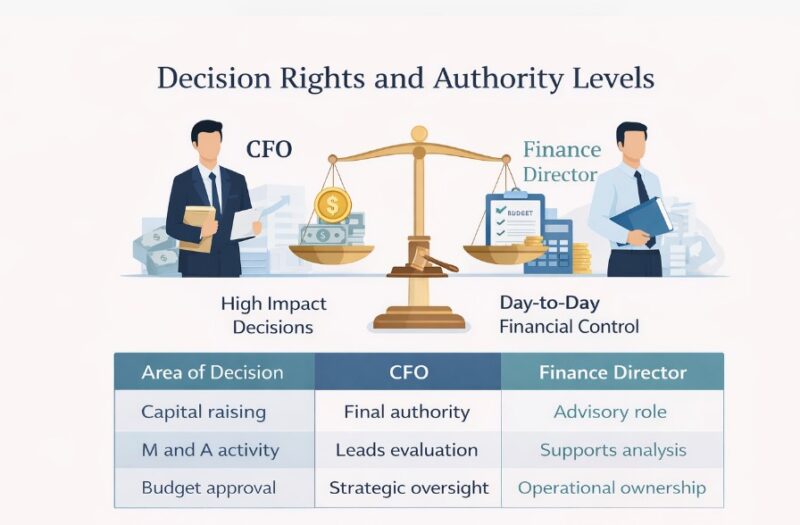
Decision rights form the clearest line in the CFO vs Finance Director comparison. A CFO typically holds authority over high impact financial decisions that affect the future of the business. This includes approving major investments, debt structures, acquisitions, or divestments. The CFO is often the final financial voice in executive debates.
A Finance Director usually operates within defined boundaries. Authority covers day-to-day financial decisions, sign-offs on budgets, and operational spending controls. Larger strategic calls are escalated upward.
| Area of Decision | CFO | Finance Director |
| Capital raising | Final authority | Advisory role |
| M and A activity | Leads evaluation | Supports analysis |
| Budget approval | Strategic oversight | Operational ownership |
The table shows how authority increases with strategic exposure. The distinction protects governance clarity and speeds up decision making.
Operational Depth Versus Strategic Breadth
While CFOs operate across the entire business, Finance Directors bring deeper operational focus. The Finance Director often acts as the backbone of financial discipline, ensuring systems, processes, and reporting remain accurate under pressure. This role is essential during scaling phases where complexity increases quickly.
A useful way to frame this difference is through responsibility layers:
- Finance Directors ensure the numbers are right
- CFOs ensure the numbers support the right decisions
A CFO is responsible for aligning financial strategy with overall business objectives, while a Finance Director ensures financial operations support that strategy accurately and consistently.
This distinction explains why some companies employ both roles. One guards precision, the other guards direction.
Company Size Changes Everything

Did you know that in small to mid-sized companies, one person often performs both CFO and Finance Director functions? As revenue grows and external scrutiny increases, the roles usually split. Investors, banks, and boards often expect a CFO once funding rounds or complex financial structures appear.
In practice:
- Startups may begin with a Finance Director handling both roles
- Growth-stage firms add a CFO for strategic leadership
- Mature organizations separate duties for stronger governance
Understanding this evolution helps businesses plan finance leadership in stages, instead of reacting too late. It also helps professionals position themselves correctly when applying for senior finance roles.
Conclusion
The CFO vs Finance Director debate is not about hierarchy alone, but about purpose. A CFO shapes financial direction and holds authority over long-term decisions. A Finance Director protects financial integrity and drives operational excellence.
Both roles are critical, but they serve different needs at different stages of a company’s journey. Clear definitions, aligned expectations, and correct hiring choices prevent overlap and confusion.
When businesses understand the scope and decision rights of each role, finance leadership becomes a growth driver rather than a bottleneck.